


SPWAC gratefully accepts donations
to support our programs
SPWAC In partnership with World Affairs Council of Connecticut

invites you to join this symposium with Sharon Weinberger hosted by Jim Falk
Who will shape the future of War -
the Pentagon or Silicon Valley?
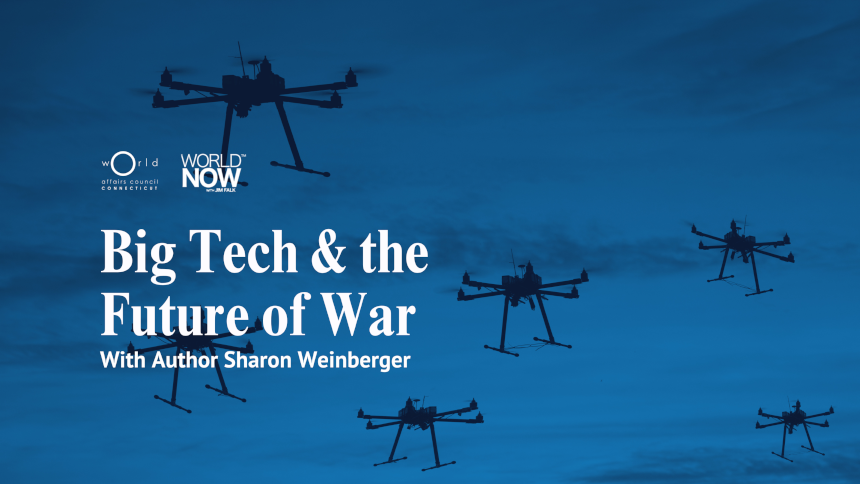
Big Tech is transforming the battlefield. Artificial intelligence, autonomous weapons, drones, and private technology companies are changing not only how wars are fought, but who holds power over the technologies that define national security.
Sharon Weinberger, author of Valley of Death: How Big Tech is Fueling the Future of War and veteran national security correspondent, joins WorldNow for an inside look at Silicon Valley’s growing influence on the Pentagon – and the technologies that could determine the next era of warfare.
Meet the Guest
 Sharon Weinberger
Editor-in-Chief of The Bulletin of Atomic Scientists
Sharon Weinberger has been writing on national security issues for more than 25 years, and was most recently the National Security Editor at The Wall Street Journal from 2022 to 2026. Previously, she was the Washington, D.C., bureau chief for Yahoo News, and before that, the executive editor for news at Foreign Policy magazine. She is the author of the forthcoming book Valley of Death: How Big Tech Is Fueling the Future of War. Her prior books include The Imagineers of War, A Nuclear Family Vacation and Imaginary Weapons.
Weinberger was a 2026 Omidyar Network reporter-in-residence and has also held fellowships at the Radcliffe Institute for Advanced Study at Harvard University, MIT’s Knight Science Journalism program, the Woodrow Wilson International Center for Scholars, the International Reporting Project at Johns Hopkins School of Advanced International Studies, and Northwestern University’s Medill School of Journalism. Her writing has appeared in the Wall Street Journal, New York Times, Washington Post, New York Magazine, Nature and WIRED, among many other publications. She is a member of the Council on Foreign Relations and lives in Washington, D.C.
Meet the Host
 Jim Falk is Vice Chairman of the Board of Global Santa Fe, a member organization of the World Affairs Councils of America. He is the host of WorldNow with Jim Falk and the producer and host of The Forum, the weekly public affairs program on KSFR-FM, Santa Fe Community Radio (KSFR.org).
A member of the Council on Foreign Relations, Falk led the World Affairs Council of Dallas/Fort Worth as President and CEO from 2001 to 2021, helping expand the organization's role as one of the nation's leading forums for international affairs and public policy. His guests have included diplomats, senior intelligence officials, policymakers, military leaders, scholars, journalists, and bestselling authors from around the world.
Through WorldNow and The Forum, he continues his commitment to fostering informed, civil dialogue on the international, political, social, and cultural issues shaping our world.
About the Book
 Valley of Death: How Big Tech is Fueling the Future of War by Sharon Weinberger
“A knowledgeable account of Silicon Valley’s growing influence on Washington, a relationship with potentially huge pitfalls.” – Kirkus Reviews
A veteran national security correspondent reveals how a new military-industrial complex is arising from the cradle of Silicon Valley, with vast implications for American democracy and the global balance of power.
Elon Musk, Peter Thiel, and Alexander Karp. These tech titans are fast becoming some of the most powerful figures in the realm of national security, with enormous implications for us all. As Sharon Weinberger reveals in this gripping account, the American military and spy agencies helped to create Silicon Valley as we now know it, and some of its biggest and most valuable companies today owe much of their success to the Pentagon and CIA.
Beginning with the War on Terror and accelerating under Donald Trump, however, the old alliance between elected leaders in Washington and the unelected CEOs of Silicon Valley has grown increasingly uneasy as power shifts to the private sector and Big Tech exerts greater influence over its old patrons. Companies like SpaceX and Palantir are proudly supporting – and quietly shaping – US national defense, whether by providing spies and soldiers with AI and cloud-computing tools or actual military hardware such as microwave weapons, hypersonic missiles, and advanced drones.
What happens when mercurial billionaires like Elon Musk control weapons and technologies that were once the preserve of the US government? How will this new military-industrial complex affect the way wars are fought, or even which wars are fought? That is the urgent question before us today—and as Weinberger reveals, it is one on which our collective future might well hinge.